
Does the transaction price differ from fair value: does this always result in a gain or loss?
May 10, 2023 May 10, 2023, 10:00 PMDoes the transaction price differ from fair value: does this always result in a gain or loss?
Does the transaction price differ from fair value: does this always result in a gain or loss?
 Olena Kharlamova
In accordance with IAS 9 “Financial Instruments” (paragraph 5.1.1), with the exception of trade receivables, companies must measure a financial asset or financial liability upon initial recognition at its fair value plus or minus (in the case of a financial asset or financial liability not measured at fair value through profit or loss) transaction costs that are directly attributable to the acquisition or issuance of the financial asset or financial liability.
At the same time, if the fair value of a financial asset or financial liability at initial recognition differs from the transaction price, the standard requires the following to be taken into account.
The best evidence of a financial instrument’s fair value upon initial recognition is usually the transaction price (i.e., the fair value of the consideration given or received). If an entity determines that the fair value at initial recognition differs from the transaction price, the entity accounts for the instrument as of that date as follows:
- At fair value, if the relevant fair value is evidenced by a quoted price in an active market for an identical asset or liability (i.e., Level 1 inputs) or is based on a valuation method that uses only data from observable markets. An entity recognizes the difference between the fair value at initial recognition and the transaction price as profit or loss.
- In all other cases, at fair value, adjusted for deferred tax asset between fair value at initial recognition and the transaction price. After initial recognition, an entity recognizes the deferred difference as profit or loss only to the extent that it is attributable to a change in a specific factor (including time) that market participants would take into account in pricing such an asset or liability.
Therefore, if fair value is determined based on publicly available observable data, the difference between the transaction price and fair value is recognized in profit or loss and reported in the statement of comprehensive income in the period in which the transaction occurred.
If the calculation of fair value relies, among other things, on internal (unobservable) data, or if the fair value measurement is based solely on internal data, the difference between the transaction price and fair value is recognized as deferred income or deferred expense, reported in the statement of financial position, and subsequently gradually recognized in the statement of comprehensive income. In the basis for conclusions to IASB Discussion Paper 13 “Fair Value Measurements,” the IASB noted that many respondents suggested that IASB’s “IFRS” and U.S. GAAP should have the same requirements regarding the recognition of gains or losses upon initial recognition. However, the IASB decided that determining whether to recognize a gain or loss on the first day is beyond the scope of the fair value measurement project. The Board noted that the measurement basis for the initial recognition of financial instruments under IFRS and U.S. GAAP is not always the same, and therefore the Boards cannot address the issue of comparability at this time. Consequently, the IASB decided that an entity will refer to the relevant IFRS for an asset or liability when determining whether to recognize these amounts. The IASB concluded that if the relevant IFRS does not specify whether to recognize these amounts, and if so, where to recognize them, an entity should recognize them in profit or loss. And since IAS 9 “Financial Instruments” provides clear guidance on when to recognize gains/losses and when to recognize deferred income/expenses, it is IAS 9 that should be followed. In contrast, IAS 3 “Business Combinations” and IAS 41 “Agriculture” require the recognition of “gains or losses on the first day,” even if fair value is measured using unobservable inputs.
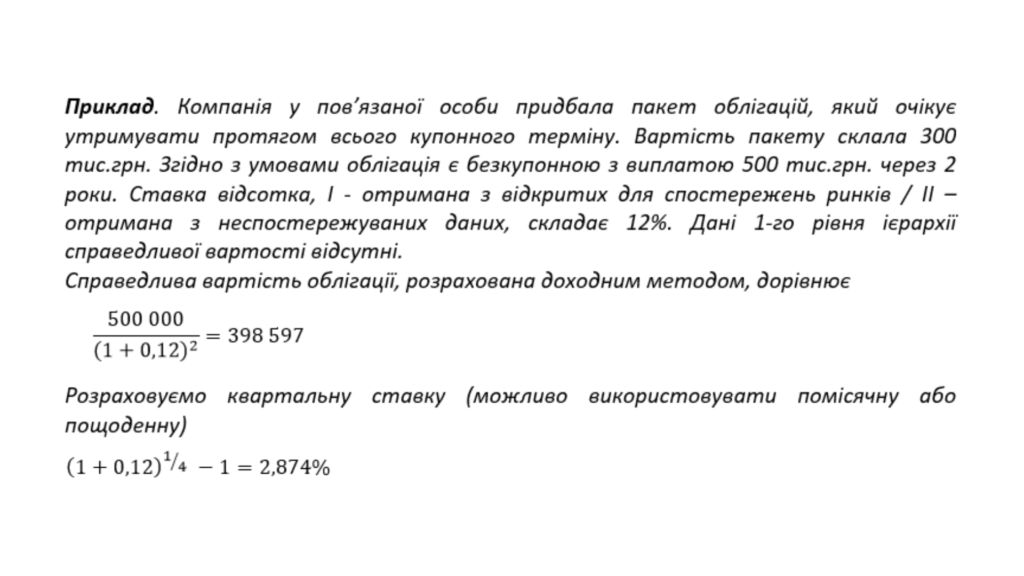
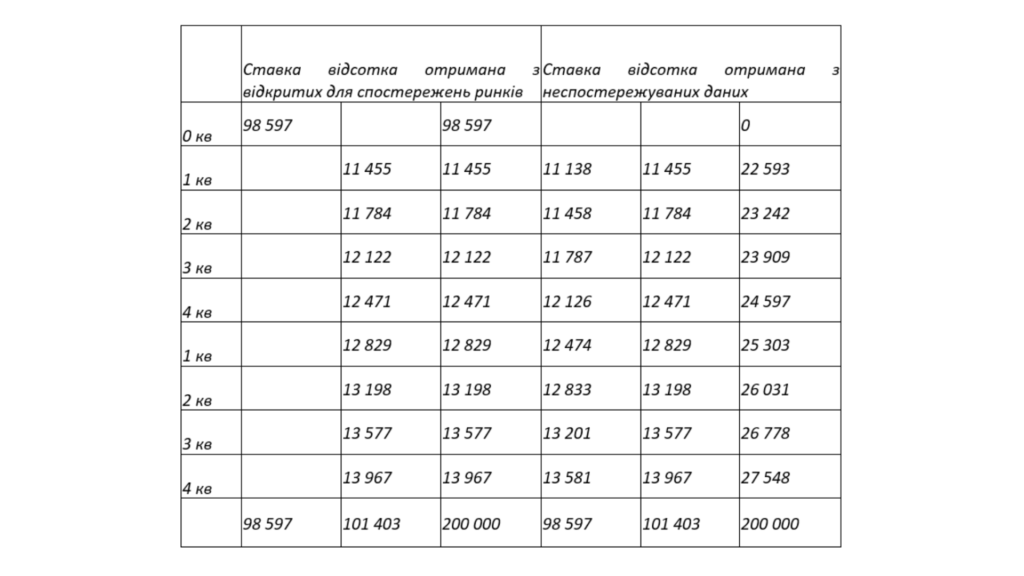
Interest rate derived from observable markets
Initial recognition
Debit Financial assets 398,597
K_t Cash 300,000
K_t Revenue from initial recognition 98,597
Accrual of interest income
Debit Financial assets 11,455
K_t Interest income from financial assets 11,455
Interest rate derived from unobserved data
Initial recognition
Debit Financial assets 398,597
K_t Cash 300,000
K_t Deferred revenue 98,597
Accrual of interest income
Dr. Financial assets 11,455 (398,597 × 2.874%)
Dr. Deferred Revenue 11,138
K_t Income from financial assets 22,595
If you’d like to explore the calculations above in detail—and more—we recommend our latest webinar, “Financial Instruments inIFRS: Accounting from Recognition to Disposal with Examples” >>> https://amsfo.com.ua/course/fin-instrumenty-v-msfz/
© Olena Kharlamova










 Ukrainian
 Armenian
 Azerbaijani
 Bulgarian
 Czech
Czech Danish
 Dutch
Dutch Estonian
 Finnish
 French
 Georgian
 German
 Irish
Irish Italian
 Kazakh
 Latvian
 Lithuanian
 Polish
 Portuguese
 Romanian
 Serbian
 Slovak
 Slovenian
 Spanish
 Swedish